FitTACWithRTMs#
- class petpal.kinetic_modeling.fit_tac_with_rtms.FitTACWithRTMs(target_tac: petpal.utils.time_activity_curve.TimeActivityCurve, reference_tac: petpal.utils.time_activity_curve.TimeActivityCurve, method: str = 'mrtm', bounds: None | numpy.ndarray = None, t_thresh_in_mins: float = None, k2_prime: float = None)#
A class used to fit a kinetic model to both a target and a reference Time Activity Curve (TAC).
The
FitTACWithRTMsclass simplifies the process of kinetic model fitting by providing methods for validating input data, choosing a model to fit, and then performing the fit. It takes in raw intensity values of TAC for both target and reference regions as inputs, which are then used in curve fitting.This class supports various kinetic models, including but not limited to: the simplified and full reference tissue models (SRTM & FRTM), and the multilinear reference tissue models (Orignial MRMT, MRTM & MRTM2). Each model type can be bounded or unbounded.
The fitting result contains the estimated kinetic parameters depending on the chosen model.
- Variables:
target_tac (TimeActivityCurve) – The target TAC object.
reference_tac (TimeActivityCurve) – The reference TAC object.
method (str) – Optional. The kinetic model to use. Defaults to ‘mrtm’.
bounds (np.ndarray) – Optional. Parameter bounds for the specified kinetic model. Defaults to None.
t_thresh_in_mins (float) – Optional. The times at which the reference TAC was sampled. Defaults to None.
k2_prime (float) – Optional. The estimated efflux rate constant for the non-displaceable compartment. Defaults to None.
fit_results (np.ndarray) – The result of the fit.
Example
The following example shows how to use the
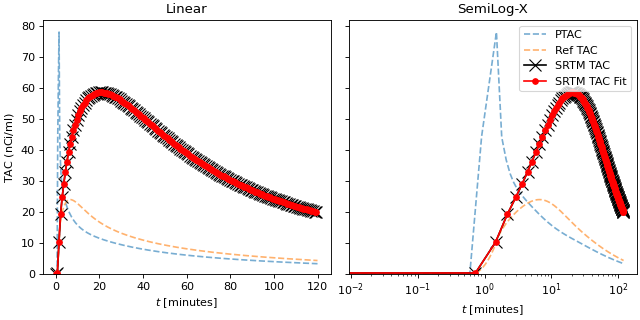
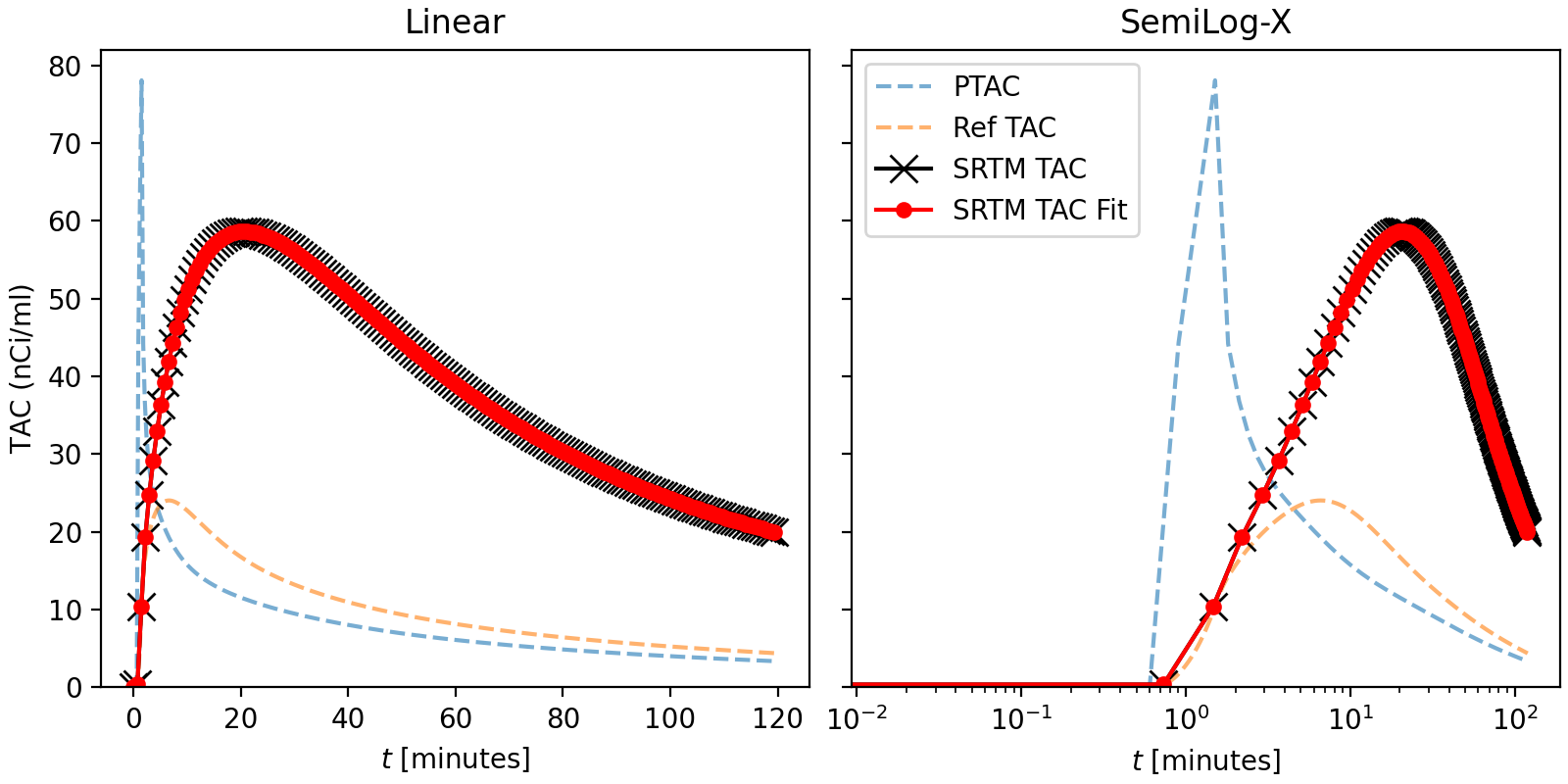
FitTACWithRTMsclass to fit the SRTM to a target and reference TAC.import numpy as np import matplotlib.pyplot as plt import petpal.kinetic_modeling.tcms_as_convolutions as pet_tcm import petpal.kinetic_modeling.reference_tissue_models as pet_rtms import petpal.kinetic_modeling.fit_tac_with_rtms as fit_rtms from petpal.visualizations.tac_plots import TacFigure as TACPlots from petpal.utils.time_activity_curve import TimeActivityCurve # Loading the input tac to generate a reference region tac input_tac = TimeActivityCurve.from_tsv("../../../../../data/tcm_tacs/fdg_plasma_clamp_evenly_resampled.txt") input_tac_resampled = input_tac.evenly_resampled_tac(8192) # Generating a reference region tac tac_times_in_minutes, ref_tac_vals = pet_tcm.gen_tac_1tcm_cpet_from_tac(tac_times=input_tac_resampled.times, tac_vals=input_tac_resampled.activity, k1=0.25, k2=0.2) reference_tac = TimeActivityCurve(tac_times_in_minutes, ref_tac_vals) test_params = dict(r1=1.0, k2=0.25, bp=3.0) # Generating an SRTM tac srtm_tac_vals = pet_rtms.calc_srtm_tac(tac_times_in_minutes=tac_times_in_minutes, ref_tac_vals=ref_tac_vals, **test_params) srtm_tac = TimeActivityCurve(tac_times_in_minutes, srtm_tac_vals) rtm_analysis = fit_rtms.FitTACWithRTMs(target_tac=srtm_tac, reference_tac=reference_tac, method='srtm') # Performing the fit and saving the results rtm_analysis.fit_tac_to_model() fit_results = rtm_analysis.fit_results[0] fit_results_dict = dict(r1=fit_results[0], k2=fit_results[1], bp=fit_results[2]) assert np.allclose(fit_results, list(test_params.values())) # Generating the SRTM TAC from the fit results fit_srtm_tac_vals = pet_rtms.calc_srtm_tac(tac_times_in_minutes=tac_times_in_minutes, ref_tac_vals=ref_tac_vals, **fit_results_dict) # Plotting the results tac_plt = TACPlots(ylabel=r'TAC $(\mathrm{nCi/ml})$') tac_plt.add_tac(*input_tac.tac, label='PTAC', alpha=0.6, ls='--') tac_plt.add_tac(tac_times_in_minutes, ref_tac_vals, label='Ref TAC', alpha=0.6, ls='--') tac_plt.add_tac(tac_times_in_minutes[::50], srtm_tac_vals[::50], label='SRTM TAC', marker='x', color='black', ms=10) tac_plt.add_tac(tac_times_in_minutes[::50], srtm_tac_vals[::50], label='SRTM TAC Fit', marker='o', color='red', ms=5) plt.legend() plt.ylim(0, None) plt.show()
(
Source code,png,hires.png,pdf)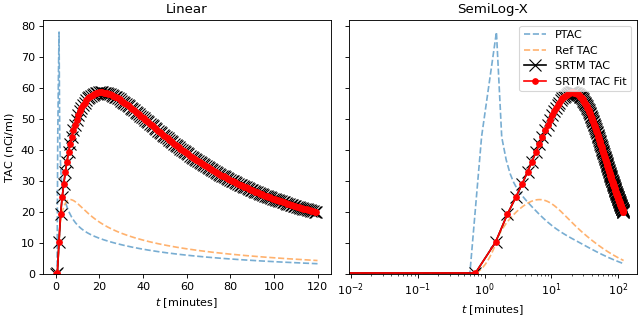
Fitting a simulated SRTM TAC#
This will give you the kinetic parameter values of the SRTM for the provided TACs.
Initialize the FitTACWithRTMs object with specified parameters.
This method sets up input parameters and validates them. We check if the bounds are correct for the given ‘method’, and we make sure that any fitting threshold are defined for the MRTM analyses.
- Parameters:
target_tac (TimeActivityCurve) – The TAC object for the target region.
reference_tac (TimeActivityCurve) – The TAC object for the reference region.
method (str, optional) – The kinetics method to be used. Default is ‘mrtm’.
bounds (Union[None, np.ndarray], optional) – Bounds for kinetic parameters used in optimization. None represents absence of bounds. Default is None.
t_thresh_in_mins (float, optional) – Threshold for time separation in minutes. Default is None.
k2_prime (float, optional) – The estimated rate constant related to the flush-out rate of the reference compartment. Default is None.
- Raises:
ValueError – If a parameter necessary for chosen method is not provided.
AssertionError – If rate constant k2_prime is non-positive.
- validate_method_inputs()#
Validates the inputs for different methods
This method validates the inputs depending on the chosen method in the object.
If the method is of type ‘mrtm’, it checks if t_thresh_in_mins is defined and positive.
- If the method ends with a ‘2’ (the reduced/modified methods), it checks if k2_prime is
defined and positive.
- Raises:
ValueError – If
t_thresh_in_minsis not defined while the method starts with ‘mrtm’.AssertionError – If
t_thresh_in_minsis not a positive number.ValueError – If
k2_primeis not defined while the method ends with ‘2’.AssertionError – If
k2_primeis not a positive number.
See also
fit_srtm_to_tac_with_bounds()fit_srtm_to_tac()fit_frtm_to_tac_with_bounds()fit_frtm_to_tac()fit_mrtm_original_to_tac()fit_mrtm_2003_to_tac()fit_mrtm2_2003_to_tac()
- validate_bounds()#
Validates the bounds for different methods
This method validates the shape of the bounds depending on the chosen method in the object.
If the method is ‘srtm’, it checks that bounds shape is (3, 3).
If the method is ‘frtm’, it checks that bounds shape is (4, 3).
- Raises:
AssertionError – If the bounds shape for method ‘srtm’ is not (3, 3)
AssertionError – If the bounds shape for method ‘frtm’ is not (4, 3).
ValueError – If the method is not ‘srtm’ or ‘frtm’ while providing bounds.
See also
fit_srtm_to_tac_with_bounds()fit_srtm_to_tac()fit_frtm_to_tac_with_bounds()fit_frtm_to_tac()fit_mrtm_original_to_tac()fit_mrtm_2003_to_tac()fit_mrtm2_2003_to_tac()
- get_failed_output_nan_array() numpy.array | tuple[numpy.ndarray]#
Returns a NaN-filled array. Used when the fit functions ends in a ValueError. The shape of the array is the same as it would be if the fit function ended without raising an error.
- Returns:
nan_array (np.ndarray) –
- Array of NaNs with the same shape as a successful fit for the
given method.
- fit_tac_to_model()#
Fits TAC vals to model
This method fits the target TAC values to the model depending on the chosen method in the object.
- If the method is ‘srtm’ or ‘frtm’, and bounds are provided, fitting functions with bounds
are used.
- If the method is ‘srtm’ or ‘frtm’, and bounds are not provided, fitting functions without
bounds are used.
If the method is ‘mrtm-original’, ‘mrtm’ or ‘mrtm2’, related fitting methods are utilized.
- Raises:
ValueError – If the method name is invalid and not one of ‘srtm’, ‘frtm’, ‘mrtm-original’, ‘mrtm’ or ‘mrtm2’.
See also
fit_srtm_to_tac_with_bounds()fit_srtm_to_tac()fit_frtm_to_tac_with_bounds()fit_frtm_to_tac()fit_srtm2_to_tac_with_bounds()fit_srtm2_to_tac()fit_frtm2_to_tac_with_bounds()fit_frtm2_to_tac()fit_mrtm_original_to_tac()fit_mrtm_2003_to_tac()fit_mrtm2_2003_to_tac()